
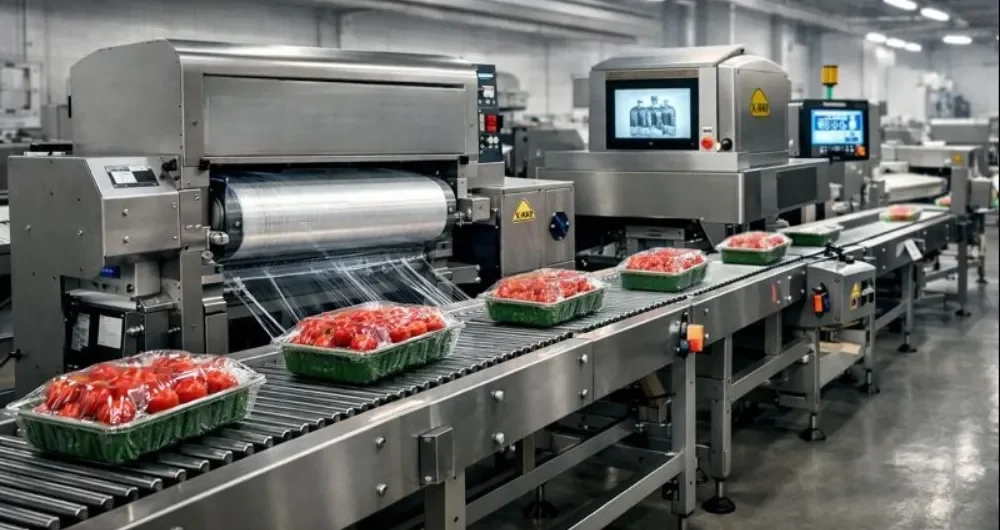
In food and industrial production, packaging is one of the most critical stages in ensuring the final product reaches the consumer. At this point, manual processes can create significant limitations in terms of speed, consistency, and traceability. Today, to overcome these limitations, in-line packaging automation has become an indispensable part of modern production facilities.
This article details what in-line packaging automation is, the advantages it offers to production lines, and the processes in which it makes a difference.
Continuity and Flow Control
In-line packaging automation ensures seamless progress on the production line. Packaging products at a predetermined speed and sequence directly and positively impacts the overall performance of the line.
Standard Packaging Quality
Automated systems apply the same packaging parameters for each product. This ensures standardized package appearance, sealing quality, and product integrity.
Reducing Operator Dependence
In manual packaging processes, errors due to human error are inevitable. In-line packaging automation reduces this dependence, offering more predictable results.
Time and Labor Savings
Automated packaging solutions make it possible to package more products in the same time frame. This results in significant time savings, especially in high-volume production facilities.
Automatic Packaging Machines
Packaging machines with different technologies such as stretch wrapping, vacuum wrapping, MAP (Map-Controlled Packaging), or tray sealing are integrated into the production line according to the product type and production requirements.
Weight Control Systems
The accuracy of the packaged products is automatically checked on the production line. Packages with incorrect or incorrect weight are removed from the production line.
Visual and Physical Inspection Systems
Factors such as package integrity, sealing quality, or the risk of foreign objects are monitored by automated control systems.
Separation and Rejection Mechanisms
Defective packages are automatically removed from the line without disrupting the production flow. This ensures that only suitable products continue to be shipped.
Hygiene, traceability, and product safety are paramount in the food industry. In-line packaging automation offers significant advantages in meeting these requirements:
Minimizing contact with the product.
Maintaining hygiene standards during the packaging process.
Packaging capacity suitable for production speed.
Adaptable structure for different product types.
These characteristics make automation a critical necessity in fresh and processed food production.
With the Industry 4.0 approach, in-line packaging automation is supported by digital monitoring and data collection systems. Packaging lines can now be analyzed in terms of speed, capacity, downtime, and error rates.
Thanks to this data:
Digital integration transforms packaging automation from simply a machine investment into a strategic production tool.
A well-designed in-line packaging automation system provides businesses with not only operational but also commercial advantages:
These advantages strengthen brands' position in the market and support sustainable growth.
Increased production volumes, shorter delivery times, and rising quality expectations; packaging This makes automation inevitable in production processes. In-line packaging automation ensures that production lines are flexible, controllable, and scalable.
In the future, the competitiveness of manufacturing facilities will be determined not only by their production capacity but also by how intelligent and integrated their packaging processes are.